Authors: Women and Law in Southern Africa (WLSA) Zimbabwe
Year: 2021
Programme: Gender Justice
Language: English
Tags: ASM, artisanal mining, gender equality, SADC
Publication
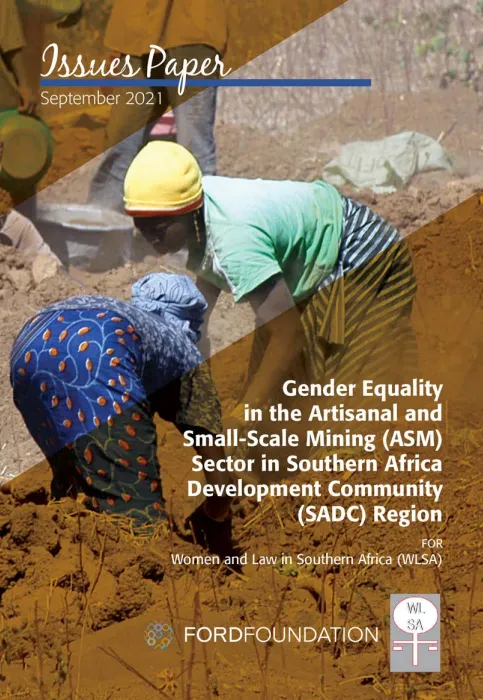
Gender Equality in the Artisanal and Small-Scale Mining (ASM) Sector in Southern Africa Development Community (SADC) Region
Abstract / Summary
An issues paper commissioned by WLSA Zimbabwe with Ford Foundation support, examining the legal and policy frameworks governing the ASM sector across SADC member states through a gender lens. It reviews mining laws in eight countries, identifies gaps in protections for women, and documents the multidimensional challenges women face in ASM — from wage inequality and sexual violence to cultural taboos and land dispossession. Comparative lessons from East and West Africa are incorporated to identify best practices.
Key Findings
- Women constitute 40–60% of the ASM workforce in parts of Africa yet earn roughly a quarter of what men earn
- ASM mining laws across SADC are largely gender-neutral on paper but discriminatory in practice, with no explicit protections against SGBV in mining contexts
- Cultural taboos (e.g. exclusion during menstruation) limit women's access to higher-value mining activities
- Zimbabwe's Mines and Minerals Act is outdated and misaligned with the Constitution's gender balance provisions
- Women face compounded disadvantages: limited land rights, no access to credit, exclusion from licensing processes, and exposure to mercury hazards
Recommendations
- Governments should align mining laws with international standards and embed human rights impact assessments in environmental review processes
- Civil society should lobby for harmonisation of inheritance and mining laws, and expand SGBV programming in mining communities
- Mining companies should adopt and enforce zero-tolerance sexual harassment policies
- Kenya's Mining Act (2016) is highlighted as a regional model worth replicating